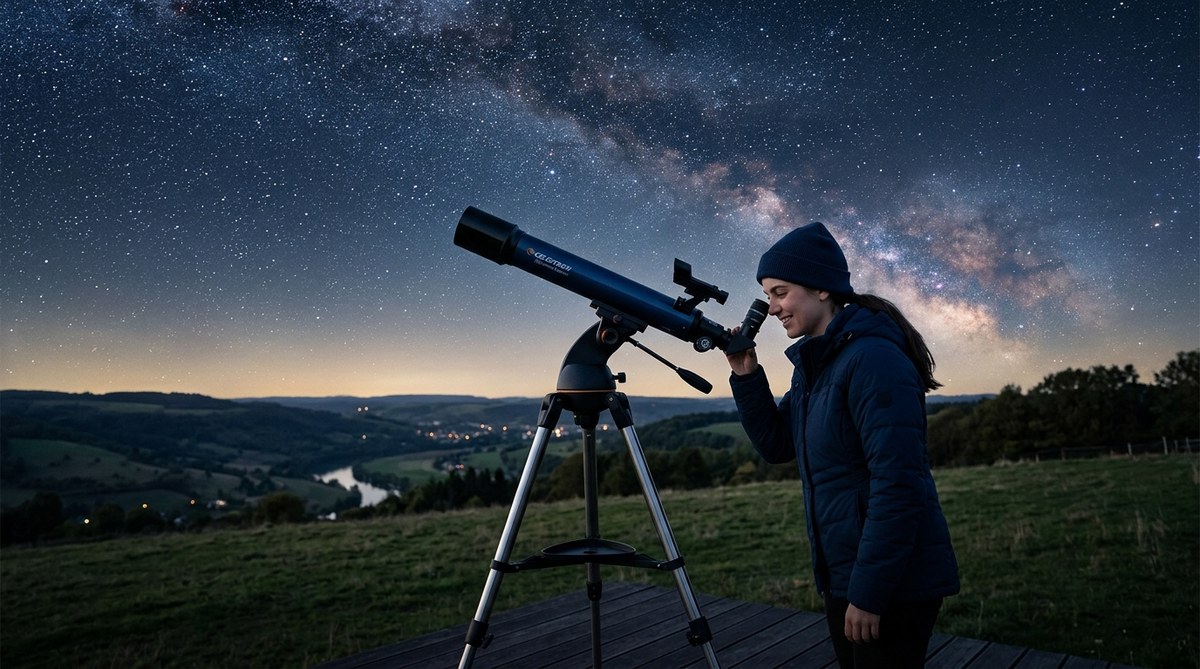
From the first night under the stars, a beginner telescope opens a doorway to the cosmos. In 2026 there are more beginner friendly options than ever, from simple table top refractors to computer aided telescopes that help you locate planets and bright deep sky objects. This guide, crafted for AstroBuyAndSell.co.uk readers, breaks down the best choices for new observers in the UK, explains the pros and cons of each design, and gives practical advice on how to pick the perfect starter telescope that fits your goals and budget.
Quick picks for 2026
- Best overall for beginners: Celestron NexStar 5SE Computerized Telescope
- Best value for learning the night sky: Sky-Watcher Heritage 130P Dobsonian
- Best budget friendly option: Celestron Inspire 100AZ Refractor
- Best smartphone guided experience: Celestron StarSense Explorer LT 80AZ
- Best portable travel option: Celestron Travel Scope 70 DX
These picks cover a range of learning styles. If you want a sit down, put it together once and start observing with minimal friction, one of the computer aided or smartphone guided models will suit you well. If you prefer a simple push to the sky experience that emphasizes learning the constellations and sky lore, a Dobsonian or refractor with an easy mount is your friend. And for families and travelers, a compact portable scope makes spontaneous star gazing a reality.
What makes a good beginner telescope in 2026
Before we jump into specific models, here are the core factors to weigh when buying your first telescope:
- Ease of use: Look for simple setup, intuitive aiming, and clear alignment or finder options.
- Mount type: Alt azimuth (AZ) is typically easiest for beginners; Dobsonian mounts are famously simple for visual observing; equatorial mounts require more learning but are great for tracking.
- Aperture vs portability: Larger apertures gather more light but add weight and cost. A good balance is often 100 to 130 mm for beginners who want a bright view without fighting with a heavy setup.
- Optical design: Refractors stay in collimation pretty easily and are low maintenance; reflectors deliver more aperture per dollar; catadioptrics are versatile but pricier.
- Accessories: A sturdy tripod or base, a few eyepieces, and a good finder scope can dramatically improve your experience.
- Future growth: Consider whether you want to explore planetary observing, deep sky targets, or astrophotography later. A model that scales with your interest will save you from upgrading too soon.
In depth: Best telescopes for beginners in 2026
Each of the following models brings something different to new stargazers. We highlight who it’s best for, what you get, and practical reasons to buy or skip.
Celestron NexStar 5SE Computerized Telescope
Specifications
- Aperture: 125 mm refractor style with Schmidt Cassegrain optics
- Focal length: 1250 mm
- Mount: Computerized fork mount with GoTo optics
- Weight: Heavier than most beginner setups, require a sturdy surface and power source
Reasons to buy
- The built in database can guide you to planets, the Moon, and bright deep sky objects with minimal learning curve.
- Compact for the aperture and surprisingly portable once on a sturdy tripod.
- Excellent for beginners who want to see a lot with relatively little manual searching, which can speed up the learning process.
Reasons to avoid
- It is not the lightest option and requires a consistent power source.
- The price is higher than many basic beginner kits.
- It is a more ambitious purchase if you are completely new to astronomy and want to dip your toe in slowly.
Overall, the NexStar 5SE is ideal for someone who wants a guided first night under the sky and then wants to grow with the instrument. It works well for planetary viewing and can reveal some brighter deep sky objects as your skill increases. If you are curious about astronomy as a long term hobby, this is a strong investment in the learning curve.
Sky-Watcher Heritage 130P Dobsonian
Specifications
- Aperture: 130 mm
- Optical design: Dobsonian reflector
- Mount: Dobsonian base, manual altitude movement
- Weight: Light enough for one person to move, highly portable
Reasons to buy
- Extraordinary value for the light gather ability in a compact 130 mm package.
- Very easy to use for visual observing; setup is quick and intuitive.
- Excellent for learning the night sky and identifying major constellations and bright objects.
Reasons to avoid
- Manual aiming requires some practice; no computerized go to assistance.
- Not ideal for long exposure astrophotography, more about visual observing.
The Heritage 130P is a classic beginner choice that many hobbyists return to as their first telescope. Its simplicity and price point make it a favorite for families and clubs.
Celestron Inspire 100AZ Refractor
Specifications
- Aperture: 100 mm
- Optical design: Refractor
- Mount: Alt-azimuth with simple, push to alignment
- Weight: Lightweight and easy to carry
Reasons to buy
- Very beginner friendly with simple assembly and operation.
- Clear, bright views of the Moon, planets, and bright deep sky objects.
- A good balance between quality and cost for new astronomers who want minimal maintenance.
Reasons to avoid
- Limited maximum light gathering compared to larger aperture options.
- For longer hikes or travel you may wish for something even lighter or even more compact.
The Inspire 100AZ is a no fuss option for those who want a straightforward viewing experience with minimal extra equipment to keep track of.
Celestron StarSense Explorer LT 80AZ Refractor
Specifications
- Aperture: 80 mm
- Optical design: Refractor
- Mount: Alt-azimuth with smartphone guided alignment
- Weight: Very portable
Reasons to buy
- The StarSense technology uses your smartphone to map the sky and guide your target.
- Excellent for absolute beginners who want to learn the sky without manual star hopping.
- Lightweight enough for kids to help set up or carry on short trips.
Reasons to avoid
- The smaller aperture means you will see faint objects less well compared to larger scopes.
- Smartphone guided systems sometimes require a stable phone connection for best performance.
StarSense Explorer is a modern twist on the beginner kit, enabling a guided, quick path to seeing the heavens.
Celestron Travel Scope 70 DX Portable Telescope
Specifications
- Aperture: 70 mm
- Optical design: Refractor
- Mount: Alt-azimuth tabletop tripod
- Weight: Ultra portable
Reasons to buy
- The most portable option on the list; perfect for travel and spontaneous stargazing.
- Great for kids and beginners who want to bring a telescope on hikes or road trips.
- Simple to set up and use on any flat surface.
Reasons to avoid
- Small aperture limits what you will see, particularly faint galaxies and nebulae.
- Not designed for serious astrophotography or deep sky exploration.
This Travel Scope is a superb entry point for a family or traveler who wants a lightweight opportunity to peek at the night sky without heavy gear.
How to choose the right telescope for your needs
If you are new to astronomy, use the following decision guide to match your goals with a model.
- If you want effortless sky guiding and a library of targets at your fingertips, choose a computerized or smartphone guided instrument.
- If you value pure observing and you want the most bang for your buck per inch of aperture, a Dobsonian is tough to beat for visual astronomy.
- If portability is your top priority for travel or family outings, pick a compact refractor or a small travel scope.
- If you want to explore astrophotography later, consider a scope that can be mounted on a stable tripod with room for a simple camera or smartphone attachment.
Practical beginner tips for your first nights
- Start with the Moon and bright planets. They are the most forgiving targets for a new observer.
- Learn the sky by using a star map or a smartphone app to identify bright constellations before you dive into deep sky targets.
- Keep your first nights under 60 to 90 minutes to avoid fatigue and eye strain; let your eyes adjust to darkness.
- Allow the telescope to cool to ambient temperature for at least 10 to 15 minutes before observing. This improves image quality.
- Take notes after each observing session; record what you saw and where in the sky, along with the conditions.
- Use the lowest magnification first; you can always switch to higher magnification eyepieces for closer looks.
Where to begin observing in the UK
- Urban observers: Start with brighter targets like the Moon, Orion Nebula, Orion’s Belt, and bright planets.
- Suburban to rural observers: You can push further into bright galaxies and nebulae when the sky is dark enough.
- Planning: The best observing times in the UK often align with new moon phases and clear skies. Always check the forecast and light pollution level for your site.
Beginner astronomy and astrophotography
Many beginners want to take photos as soon as they see something through the telescope. Here is a practical intro to getting started with imaging:
- Start with simple phone adapters for basic planetary shots or lunar photography. These are cheap and easy to use.
- For basic deep sky photography, you will likely want an equatorially mounted telescope with a camera. If you are new to this, start with a remote shutter release and shorter exposure times.
- Stacking software can dramatically improve brightness and detail. Free tools like DeepSkyStacker or Sequator are popular for stacking multiple frames.
- Consider a light pollution filter for brighter deep sky objects if you are observing from a city or suburb.
AstroBuyAndSell.co.uk can be a great resource to find guide prices and trustworthy deals when you are ready to upgrade or add accessories. Our classifieds page often features beginner friendly bundles that include eyepieces, finder scopes, and stable mounts.
What to expect on your first nights
- You will likely see the Moon beautifully in detail and a handful of bright planets such as Jupiter and Saturn if they are visible.
- Dimmer deep sky objects will require more aperture and dark skies, so manage expectations as a beginner.
- You will become faster at locating targets as you learn the sky, and a good star chart or app will become your best friend in the field.
FAQ for beginner telescope buyers
- What is the easiest telescope for a complete beginner?
-
A small to medium sized refractor or a simple Dobsonian is often the easiest way to start. They require minimal alignment and are forgiving to learn with.
-
Do I need a computer controlled telescope?
-
Not strictly. A computer aided telescope can dramatically reduce the time spent finding things, but it is not required. If you enjoy learning the sky through star hopping, a simple manual scope is a great teacher.
-
How important is aperture for a beginner?
-
Aperture matters for light gathering and the ability to reveal faint objects. For most beginners, 100 to 130 mm is a healthy balance of light gathering and portability.
-
Should I buy used or new?
- For first purchases, new equipment often comes with a warranty and peace of mind. However, used equipment from trusted sources can be a good value if you know what to check for and you are comfortable with the gear availability.
Final thoughts and next steps
If you are new to astronomy and want the most reliable and user friendly path into stargazing in 2026, consider starting with a model that aligns with your comfort level and your budget. The best part about this hobby is how quickly you can grow with your gear. A simple refractor can give you sharp, steady views and a solid learning curve, while a Dobsonian can maximize your observing time with straightforward operation. For a technology infused learning curve, a computer guided telescope will keep you engaged and help you see more on the first night.
We hope this guide helps you choose the right telescope for your first steps under the night sky. If you are ready to buy or just want to compare options, browse our AstroBuyAndSell.co.uk listings for new and used beginner telescopes, accessories, and bundles. The community here loves to share observing tips and space news, so you are never far from help or inspiration on your journey.
Would you like a personalized recommendation based on your budget, location, and observing goals? Tell us your rough budget and whether you prefer visual observing or photography, and we can tailor a short list to match your needs.